Our role in the nuclear fuel cycle
Our role in the nuclear fuel cycle

-
1. Mining
Uranium ore is extracted, purified and milled to become uranium oxide (U3O8).
-
2. Conversion
U3O8 is chemically converted into uranium hexafluoride (UF6), also known as feed, and transported to one our enrichment facilities.
-
3. Enrichment and feed materials
Our enrichment process starts with the arrival of our customers’ UF6 at our enrichment facilities. We heat UF6 to turn it into a gas and then feed it into our gas centrifuges. The centrifuge separates the two isotopes contained in uranium: uranium235 (U235) and uranium238 (U238). The lighter U235 is typically enriched to up to 5%, which is sufficient to sustain a continuous fission reaction in a nuclear power plant.
The flexibility of our centrifuges allows us to conserve feed material, and therefore provide enriched uranium product and natural uranium, in addition to enrichment services.
Find out more about the enrichment process below.
-
4. Fuel fabrication
Customers’ enriched uranium is transported to fuel fabricators, where it is converted into pellets, before being loaded into fuel rods.
-
5. Nuclear power generation
The fuel rods are transported to nuclear power stations, where they are placed inside reactors and used to generate steam. This drives turbines which, in turn, power electricity generators.
-
6. Electricity distribution
At the end of the nuclear fuel supply chain, nuclear power stations provide a reliable source of low carbon electricity for homes, schools, hospitals, offices and industries around the world.
-
1. Heating uranium hexafluoride (UF6) to turn it into a gas
Approved suppliers deliver UF6 to our enrichment facilities in international, standardised transport containers.
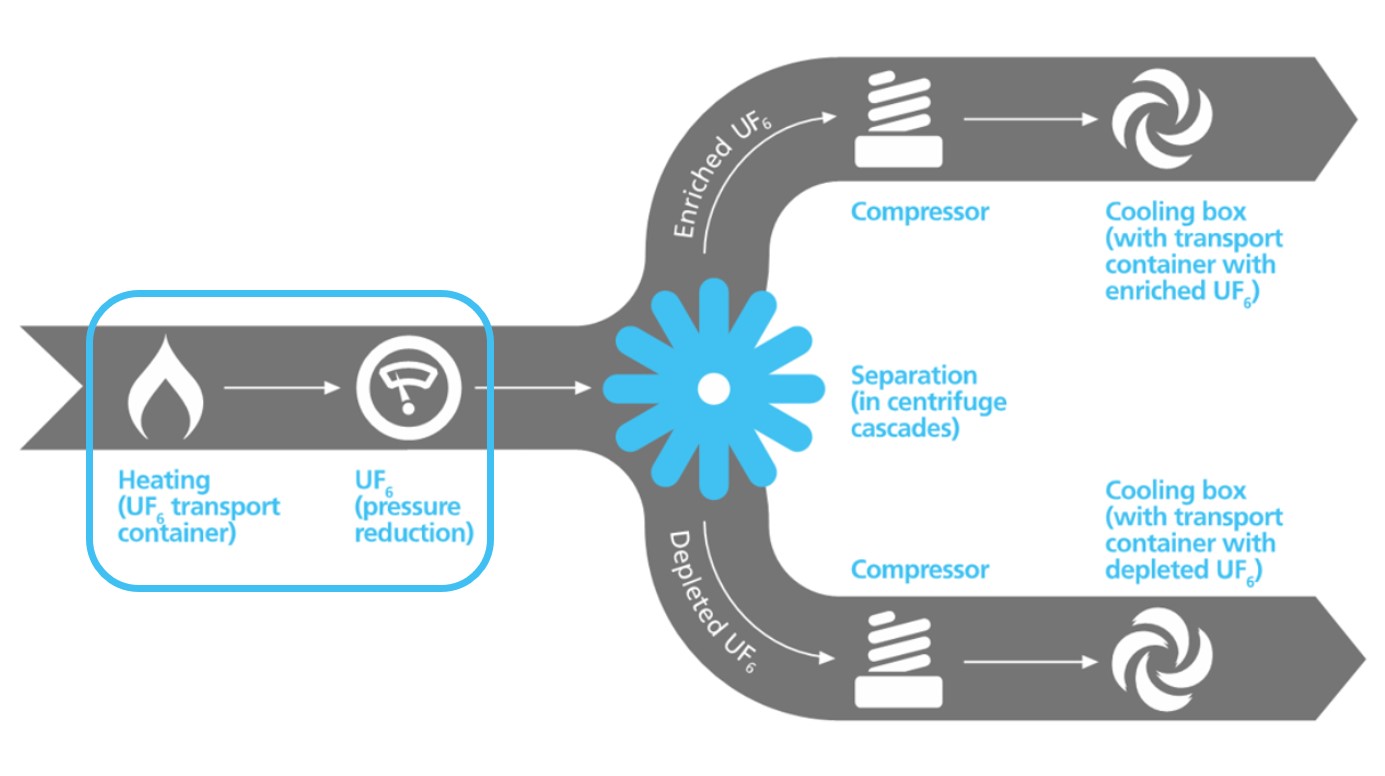
UF6 is solid at ambient temperature. At our enrichment facilities, we connect the transport container holding UF6 to the plant feed system. We then heat the container to vaporise the UF6 and turn it into gas at sub atmospheric pressure.
-
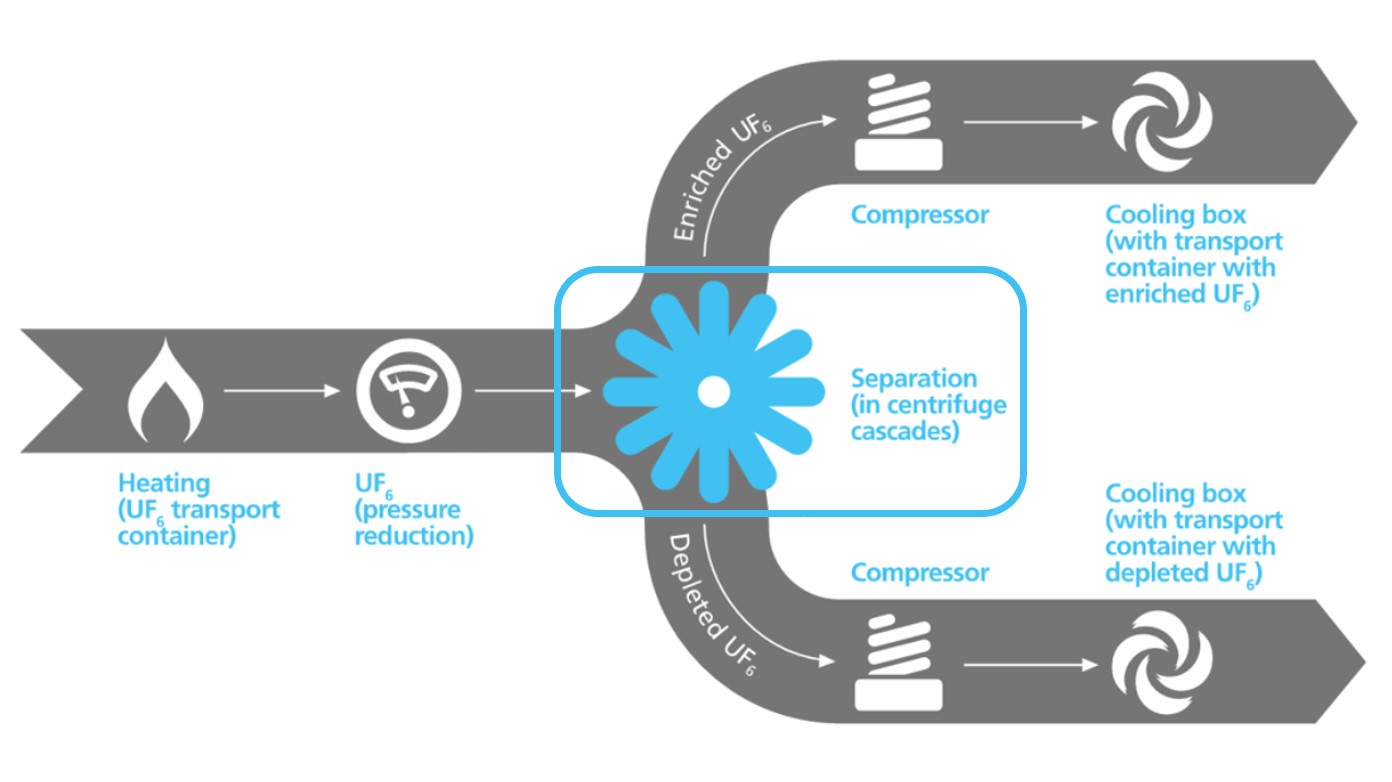
2. Spinning UF6 in high speed centrifuges to enrich it
We feed the UF6 gas into a centrifuge casing containing a cylindrical rotor which spins at high speed, separating uranium’s two isotopes. The heavier isotope uranium238 (U238) is forced closer to the cylinder wall than the lighter uranium235 (U235). As a result, the UF6 gas closer to the wall is depleted in U235 and the UF6 gas nearer the rotor axis is slightly enriched in U235. We repeat the process many times in a series of centrifuges, known as cascades, until we achieve the desired levels of U235 enrichment to meet our customers’ specifications, typically between 3% and 5%.
-
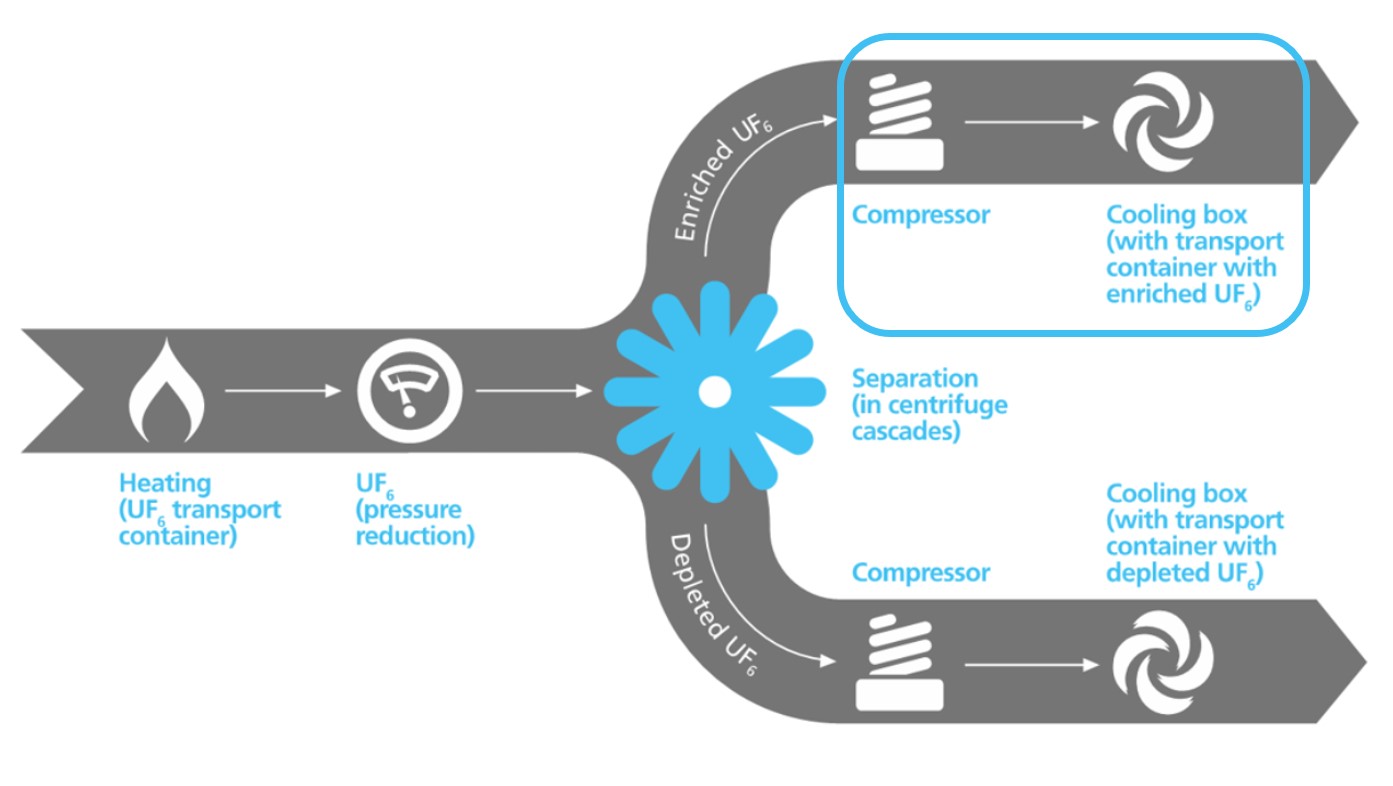
3. Compressing and cooling the enriched uranium
We feed the enriched uranium from the centrifuge cascades into a compressor and then into a cooling box containing a cylinder. As it cools, the UF6 vapour solidifies within cylinders. We homogenise the UF6 in the cylinders and check the quality of a sample before delivering it to customers. We weigh all cylinders to comply with the accounting and tracking requirements of the European Atomic Energy Community, United States Nuclear Regulatory Commission and the International Atomic Energy Agency.
-
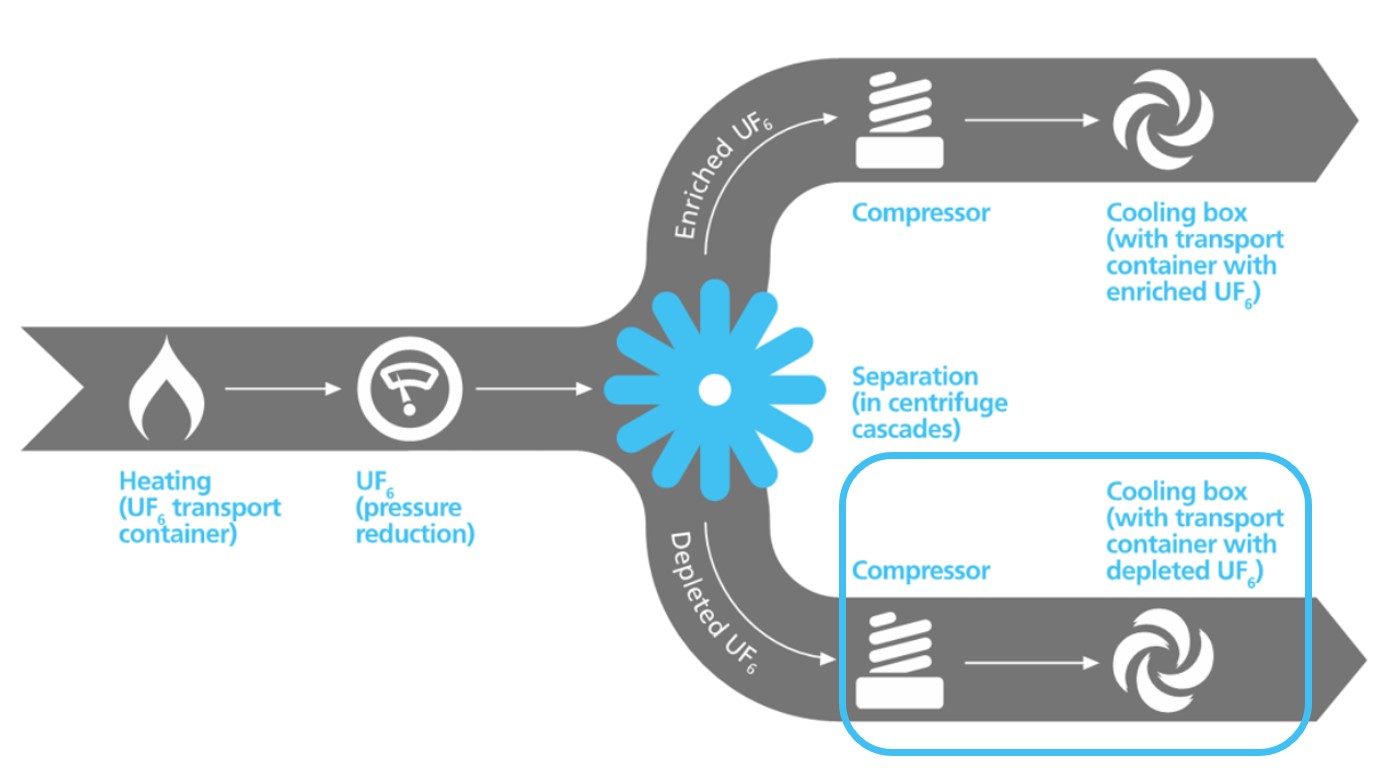
4. Storing and converting depleted uranium
The UF6 gas closer to the centrifuge wall is partially depleted in U235. This by-product is known as tails. We collect and cool tails in a cooling box containing a cylinder, weighing it to ensure all material can be accounted for. Tails still contain a low concentration of U235 and can be re-enriched if economically viable.
We store tails at our enrichment facilities in internationally approved containers pending deconversion to a chemically stable form, uranium oxide (U3O8), for long term storage for future enrichment or final disposal. Our Tails Management Facility is responsible for deconversion and converts UF6 to U3O8. This process also creates hydrofluoric acid, a valuable chemical used globally by industry.
Find out more about our Tails Management Facility here/below?.
How do we manage our by-product?
Our role in the nuclear fuel cycle does not stop at enrichment – ensuring that our by-product is responsibly managed forms an essential part of our activities.
During the enrichment process, depleted uranium hexafluoride (UF6) is produced as a by-product. Commonly known as tails, it can be managed in one of two ways:
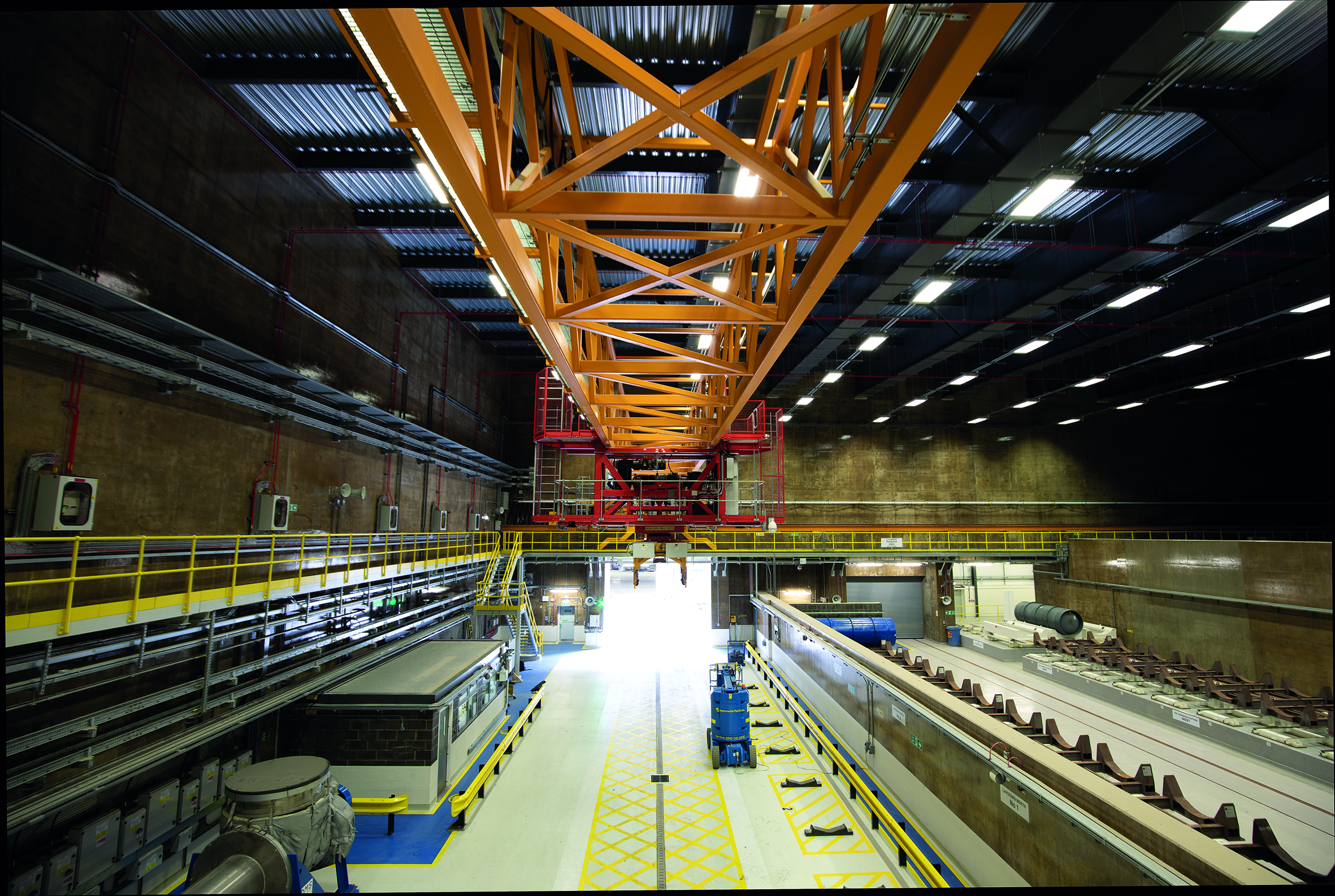
Re-enrichment
Tails still contains low levels of U235 and can therefore be passed through our centrifuges again to be re-enriched, which is a common industry practice. This promotes the conservation of resources and Urenco will take this approach whenever it is commercially viable to do so.
Storage
When it is not commercially viable to re-enrich tails, we store it safely and securely ourselves or with our partners, for enrichment at a future date or deconversion.
Deconversion involves converting tails to uranium oxide (U3O8) for longer term storage pending reuse or final disposal. Urenco has invested in a multi-million pound Tails Management Facility (TMF) in the UK to handle the deconversion process and it currently serves our European sites.
